
Murciano-Granadina
The Murciano-Granadina Breed
A Spanish dairy goat breed (Murcia and Granada), highly rustic and outstanding in milk production.
Origin & history
Native to southeastern Spain, it descends from the Pyrenean goat (Capra aegagrus), which settled in the valleys of the Segura, Darro and Genil rivers. From Granada it spread across Andalusia and from Murcia across the Spanish Levante. The Murciana and Granadina breeds were officially unified on 28 March 1979, creating the Murciano-Granadina.
- 1893
Aragó describes the Murciana and Granadina as dairy breeds (3 to 4 litres/day).
- 1960
Decree 2394/1960 — first legal recognition of the breeds.
- 1979
Official unification (28/03/1979) into the Murciano-Granadina breed.
- 16th–17th c.
Taken to the Americas by settlers; a base for creole breeds in Mexico, Brazil and Venezuela.
Characteristics
Origin
Murcia and Granada, Spain
Aptitude
Dairy
Breed Standard (ABCC)
- Profile
- Straight or slightly sub-concave.
- Coat
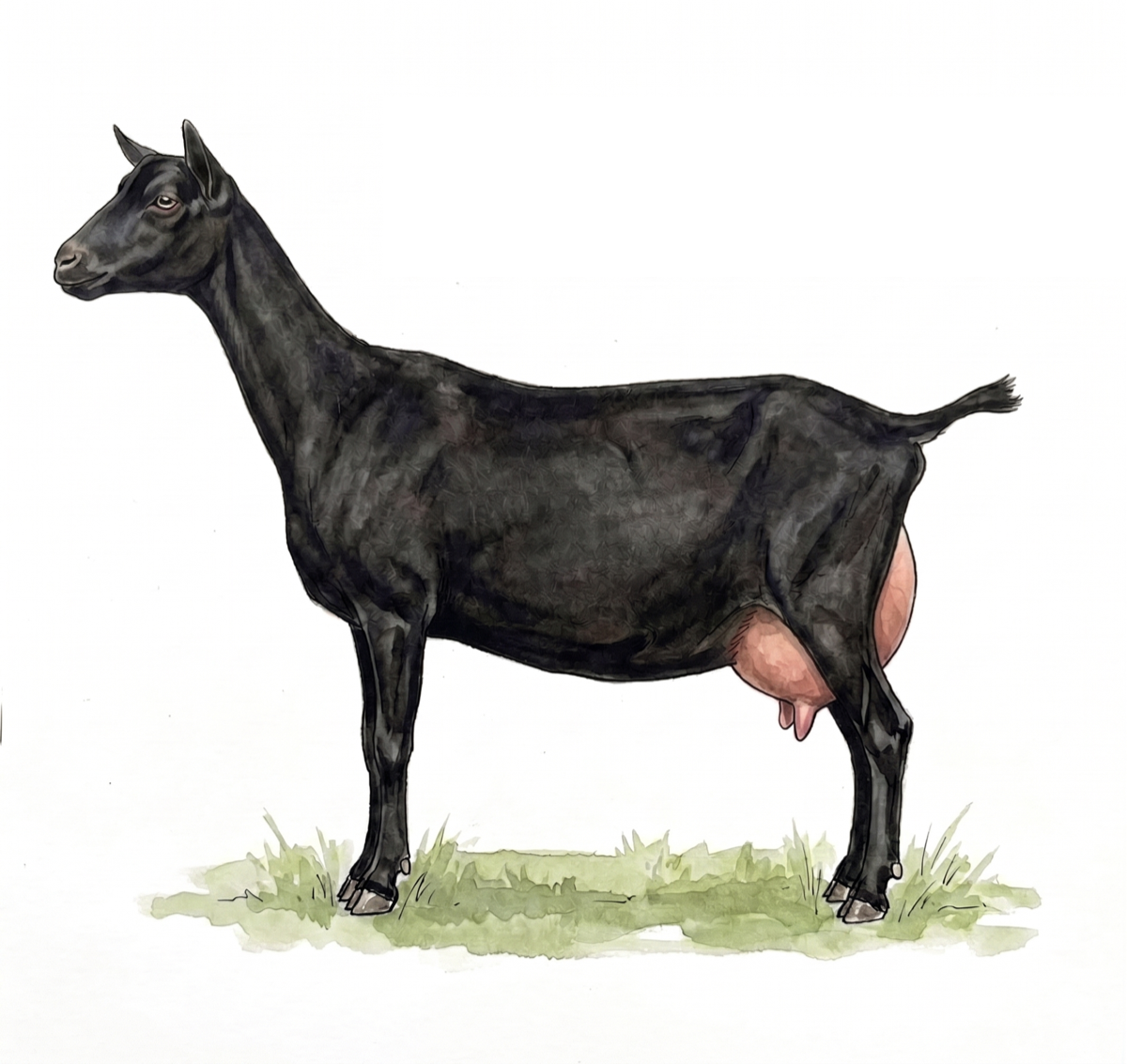
- Uniform, black or dark red (mahogany).
- Build
- Longilineal, tending to an elongated morphology.
- Hooves
- Black and strong.
- Udder
- Large, voluminous and symmetrical; fine, elastic, hairless skin.
Breed standard per the ABCC — Goat Herd Book (SRGC), Brazil. For more information, visit the ABCC Caprinos website.
🇪🇸 → 🇧🇷
Inspiration and gratitude to Caprigran
Our work is inspired by Caprigran — the National Association of Murciano-Granadina Goat Breeders (Spain), a world reference in the breed's improvement. We are grateful for their 40+ years of work and for supporting the spread of the Murciano-Granadina in Brazil — a country that, as early as the 16th–17th centuries, received the breed as a base for creole herds. For official production and selection-program data, visit the Caprigran website.